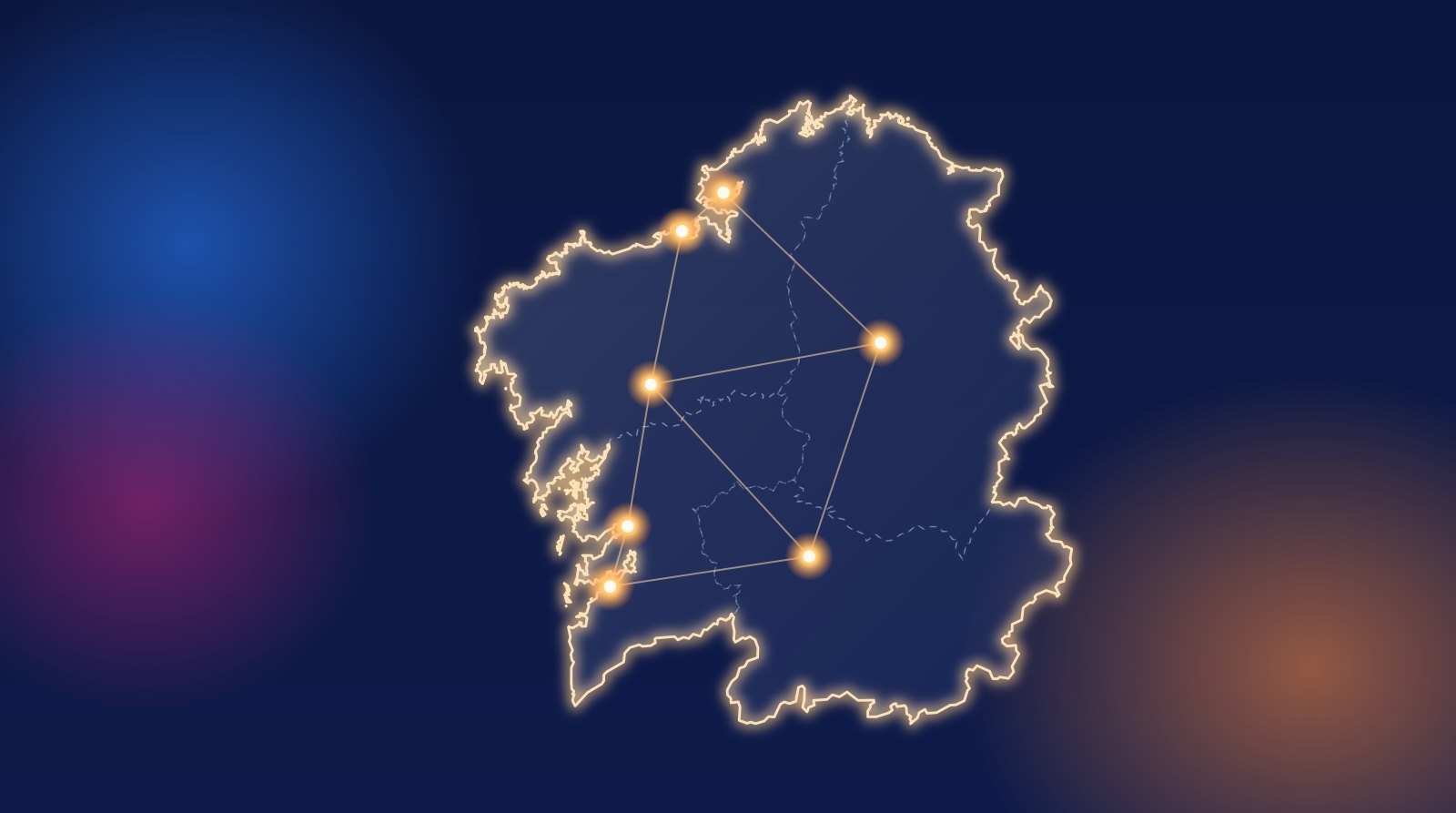
Galicia has 234,066 active businesses, and two out of three have no employees at all. Behind that figure is a person who sells, invoices, answers emails, chases payments and, when there's a moment left, gets on with the actual work. The artificial intelligence that helps that person isn't the kind that makes headlines. It's the kind that takes tasks off their plate without needing an IT department. That's what this tour of Galicia's seven cities is about: their businesses and what NAiOS has built in for each of them.
In 30 seconds
- Galicia has 234,066 businesses: 65.8% have no employees, 29.4% have fewer than ten, and only 296 have 250 or more.
- NAiOS is an AI chat that already includes your business tools: CRM, invoicing with Verifactu, accounting, email, calendar, e-signature, training, WhatsApp and agents, all on one platform.
- Seven cities, seven economies: what an automotive supplier in Vigo needs is not what a professional firm in Santiago or a cheesemaker in Lugo needs.
- Use cases by size: small businesses stop paying for five different programs, mid-sized companies bring their departments together, and large companies get their own platform under their own brand.
- Secure and easy to get started: data stored in the European Union, AI that never acts without someone confirming, and a Set-up module that guides you step by step.
- In Galician, with a team in Galicia: Iria Álvarez, IACOBUS Assistant and Almamark, NAiOS Partners in the region.
- And a date for your diary: 10 December in Vigo, VÉRTIGO 2026, the conference on artificial intelligence, cybersecurity and data protection.
Galicia in figures: a land of small businesses
Every year the Instituto Galego de Estatística publishes its business directory. The latest edition, with data as of 1 January 2024, paints this picture:
- 153,951 businesses with no employees (65.8%): self-employed people and one-person companies.
- 68,855 micro-businesses with 1 to 9 people (29.4%).
- 9,294 small businesses with 10 to 49 (4%).
- 1,670 mid-sized businesses with 50 to 249 (0.7%).
- 296 large businesses with 250 or more (0.1%).
Six out of ten are sole traders. By province, A Coruña has 93,353 businesses, Pontevedra 78,178, Lugo 33,282 and Ourense 24,644. And more than four in ten business premises are in the seven largest municipalities, led by Vigo (26,079) and A Coruña (24,438).
All of this in a region of 2.7 million people that generates 5.1% of Spain's GDP and in 2025 exported €30,939 million worth of goods, 8% of everything Spain sells abroad.
The conclusion is simple: in Galicia, talking about businesses means talking about teams of fewer than ten people. Any technology that wants to be useful here has to work for them, and grow with the ones that grow.

The sectors that drive Galicia
Three quarters of Galicia's exports come from four activities: textiles (23.7%), automotive (22.1%), capital goods (15.3%) and food (13.9%), which is mostly fishing. But the day-to-day economy is made up of many more. Here are the main ones, along with what NAiOS brings to each.
Retail, hospitality and tourism
They make up the bulk of the business landscape: 43,287 retail businesses (18.5% of the total) and 18,550 in hospitality. Almost always very small teams, with long hours and tight margins. What pays off most for them is a POS that issues compliant receipts, bookings via WhatsApp and campaigns to their regular customers.
Farming and the sea
35,287 businesses, 15.1%, work in agriculture, livestock, forestry and fishing. Galicia produces 41% of Spain's cow's milk, more than three million tonnes a year, and has almost half of the country's active fishing fleet, 49.3%. Around them work 132 fish canning and processing companies and 160 aquaculture businesses, with mussels leading the way. These are activities with many members, many deadlines and many grants: a shared calendar, alerts and the grants radar.
Industry: automotive, textiles, shipbuilding and food
Only 12,852 businesses, but carrying more weight than in the rest of the country: manufacturing accounts for 14.9% of the Galician economy, compared with 11.9% for Spain as a whole. Behind every large factory is a chain of workshops and suppliers whose livelihood depends on meeting deadlines and keeping good records: quotes, orders, delivery notes, drawings and stock.
Forestry and timber
The forestry and timber chain brings together more than 3,300 businesses, represents 1.7% of Galicia's GDP and exported more than €1,200 million in 2025. Sawmills, carpentry workshops and forestry service companies spread across Galicia, working with land plots, permits and maps.
Construction
26,706 businesses, 11.4%. Estimates, work reports, subcontractors and progress certificates: a lot of paperwork for teams that spend the day on site and need to handle it from their phones.
Professional services and technology
23,561 businesses in professional, scientific and technical activities, one in ten, plus another 3,591 in information and communications. Law firms, advisory firms, engineering firms and consultancies that sell hours and expertise: case files, contracts, signatures and a knowledge base that doesn't walk out the door when someone retires.
What NAiOS is, in one sentence
NAiOS is an AI chat that knows your business because the tools you work with are built in. It isn't an assistant you have to explain everything to every time: your customers, invoices, emails, documents and meetings all live on the same platform, and the chat works with them. Each piece is a module you switch on when you need it. Here are the main ones.
What's inside
Chat and AI
- Chat with multiple AI models, with voice so you can dictate or talk hands-free.
- Knowledge Base: upload your documents, spreadsheets or website, and the chat answers with what your business says, not with generic answers.
- Skills: instructions the chat applies automatically, so it always writes, summarises or calculates your way.
- Agents: tasks that run on their own, on a schedule or when something happens, and that ask for permission before anything sensitive.
- Connectors: Gmail, Slack, Notion and other tools you already use, within the chat's reach.
Selling and customer service
- CRM: customers, opportunities and sales follow-up, with a complete profile for every contact.
- Campaigns: prospecting with sequences from your own mailbox, and mailings to opted-in lists.
- NAiOSOmni: WhatsApp, Telegram, email and your website chat in a single inbox, with automatic replies when you're away.
- Calendar and Bookly: a calendar with a public booking link, and appointments for service businesses, with confirmation via WhatsApp.
- Forms, Social and WordPress: capture leads, schedule social media posts and run your website without leaving the platform.
Invoicing, getting paid and keeping the books
- ERP: quotes, orders, delivery notes and invoices with Verifactu, expenses and recurring billing.
- POS and Warehouse: over-the-counter sales with compliant receipts and stock control across multiple warehouses.
- Treasury: upload your bank statement and it suggests which payment matches which invoice.
- Accounting: the journal is built from what you've already invoiced, spent and collected.
Teamwork
- Mail: your usual email inside NAiOS, with shared mailboxes and a filter for unknown senders.
- Meet: video calls with recording and AI-generated minutes.
- Office, Tasks and Talk: documents and spreadsheets, task boards and internal messaging.
- HR: employee records, time tracking, holidays and absences.
- Support: your customers' issues as tickets, not as lost emails.
Paperwork, compliance and training
- Signature and Legal: contracts from templates and e-signatures with an evidence report.
- Academy: AI-powered courses, including the training the EU AI ActAI Act (EU AI Act)Regulation (EU) 2024/1689: the first comprehensive law on artificial intelligence, with obligations based on risk level requires for anyone who uses AI in their work.
- Trust: your company's trust centre, with its registers of risks, suppliers and incidents.
Industry-specific modules
- Firm, Advisory and Portal: case files, a tax calendar and a portal where clients upload their documents.
- Hotel: real-time accommodation availability, in the chat and via WhatsApp.
- CAD and GIS: open and measure AutoCAD drawings without owning the software, and view maps and geographic layers.
- Funding Radar: the open grants and subsidies that fit your business, with an alert before they close.
Nobody uses everything. A self-employed professional starts with three or four modules; a mid-sized company may end up with twenty. What matters is that data doesn't end up in silos: what comes in through a form reaches the CRM, what's sold gets invoiced, and what's invoiced gets booked.
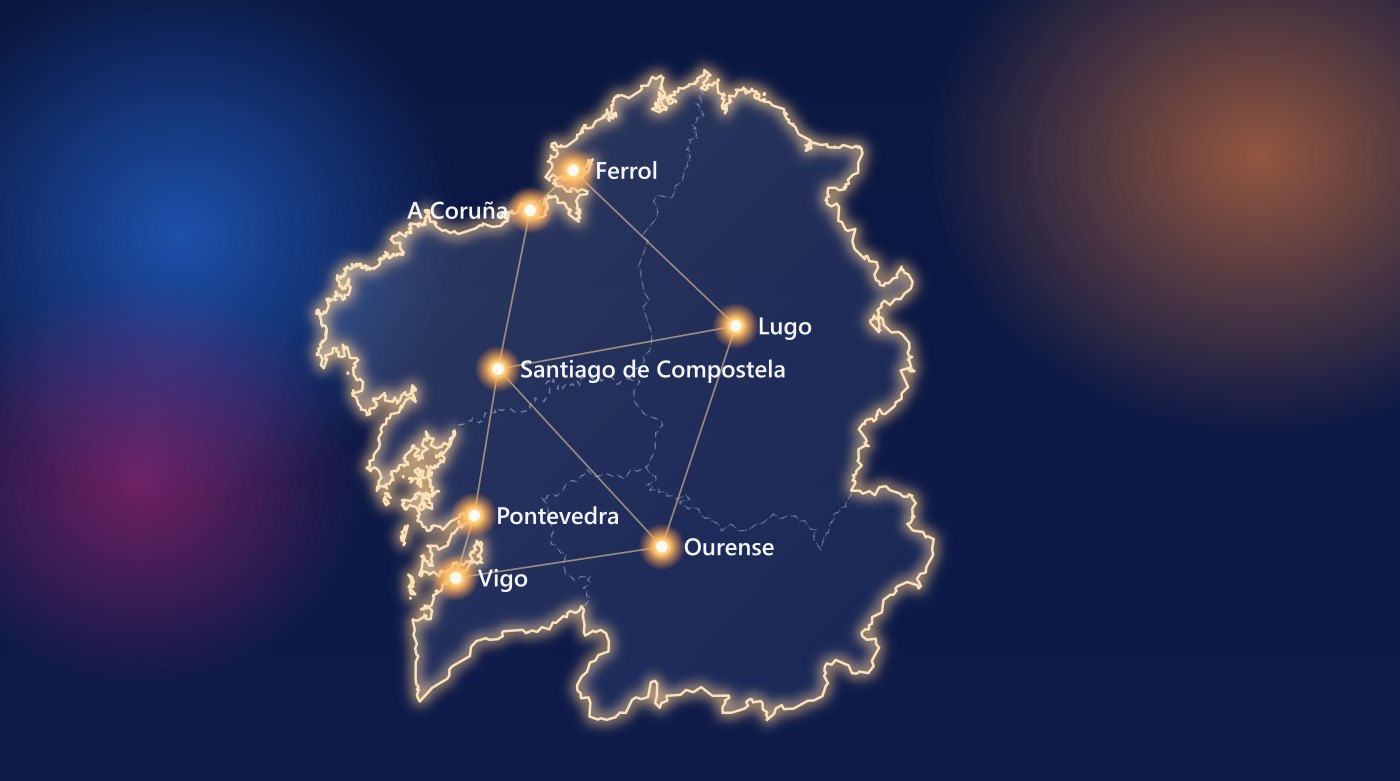
Seven cities, seven ways of doing business
Vigo
Galicia's largest city lives on the automotive industry and its suppliers, shipbuilding, fishing and canning, and a port that keeps everything moving. For an industrial supplier, the CRM tracks every quote, the ERP turns it into an order, delivery note and invoice, and Warehouse keeps stock under control. And if drawings arrive in AutoCAD format, the CAD module opens and measures them without a licence.
A Coruña
Textiles, services, banking, technology and a thriving retail scene. An agency or a shop with online sales has its opt-in mailings in Campaigns, its social media calendar in Social, WhatsApp and website chat in NAiOSOmni, and counter sales in the POS, all under the company's own brand.
Santiago de Compostela
Public administration, university, healthcare and tourism that never stops. For a professional firm there's Firm, Legal and Signature: case files, contracts and paperless signatures. For accommodation, the Hotel module answers availability questions via WhatsApp at any hour, and the knowledge base handles the usual questions.
Ourense
Retail, fashion, spa tourism and agrifood, with many family businesses and little time for admin. Here, getting the basics right makes all the difference: invoices with Verifactu, payment reminders that go out on their own, Treasury reconciling the bank, and Accounting fed by what's already been invoiced. For a spa or a beauty salon, Bookly handles appointments.
Lugo
Livestock, dairy, forestry and a well-known agrifood sector. Cooperatives and farms work with many members and many deadlines. The shared calendar and WhatsApp alerts keep deliveries organised, the GIS module shows land plots and forests on a map, and Funding Radar keeps an eye on open grants so none slip by.
Pontevedra
Services, public administration, retail and the gateway to the Rías Baixas, with all their tourism and wine. For a winery or a seasonal business, the ERP manages the catalogue and the POS the shop, Calendar and Bookly handle visits and bookings, and Campaigns lets regular customers know when the new vintage is in.
Ferrol
Shipbuilding, energy and engineering, with a long chain of supplier companies. These are project-based businesses, where documentation rules. Meet keeps the minutes of every meeting, Office and the knowledge base store what's been learnt on each project, Tasks shares out the work, and HR handles time tracking for both workshop and office staff.
Use cases: small, mid-sized and large businesses
The same platform is used in very different ways depending on how many people work in the business. Here are examples of what it solves for each group.
Small businesses: one to forty-nine people
They account for 232,100 of Galicia's 234,066 businesses, including the self-employed. Nobody here has time to spare to “handle the IT”: whatever gets adopted has to save time from the very first week.
- A self-employed plumber in Lugo. She writes the quote on her phone as she leaves the visit, turns it into a Verifactu invoice when the job is done and lets the payment reminders go out on their own. Modules: ERP, Calendar and Mail.
- A fashion shop in Ourense with four employees. It sells over the counter with the POS, tracks sizes in Warehouse, sends a WhatsApp message when an order arrives and emails a campaign to customers at the start of each season. Modules: POS, Warehouse, NAiOSOmni and Campaigns.
- An advisory firm in Pontevedra with twelve staff. It manages its client portfolio with each client's tax calendar, requests documents through a portal instead of by email and signs engagement letters without paper. Modules: Advisory, Portal and Signature.
- A physiotherapy clinic in A Coruña. Appointments are booked automatically from a link, reminders arrive via WhatsApp and the assistant answers the usual questions using the clinic's own information. Modules: Bookly, NAiOSOmni and Knowledge Base.
Mid-sized businesses: fifty to two hundred and forty-nine people
There are 1,670 of them. They already have departments, and with them the age-old problem: each one works with its own tool and the data doesn't talk.
- An automotive supplier in the Vigo area. Quotes live in the CRM and become orders and delivery notes in the ERP, and the drawings the customer sends are opened and measured without an AutoCAD licence. Every Monday, an agent prepares a summary of pending orders. Modules: CRM, ERP, Warehouse, CAD and Agents.
- A canning company in the Rías Baixas. The sales network works in the CRM, each sales rep sees only their own customers, meetings with distributors get their minutes, and staff complete the AI training required by EU regulations. Modules: CRM, Meet, Academy and HR.
- A dairy cooperative in Lugo. It communicates with hundreds of members via WhatsApp, manages the calendar of deliveries and certifications, and keeps an eye on open grants from the Xunta (regional government) so it doesn't miss any. Modules: NAiOSOmni, Calendar, Tasks and Funding Radar.
- A construction company in Santiago. Estimates, subcontractor contracts and signatures from the site, with treasury reconciling the bank and accounting fed by what's already been invoiced. Modules: ERP, Legal, Signature, Treasury and Accounting.
Large businesses: two hundred and fifty people or more
There are 296 of them. The question here isn't which tool to use, but how to give the whole workforce artificial intelligence without losing control of the data or of what's said on the company's behalf.
- An industrial group with several plants. NAiOS is deployed as its own platform, with its brand, its domain and its own mobile app. Connectors link it to existing systems, and each department has its own agents and knowledge base.
- A services company with hundreds of people out in the field. Time tracking, holidays and work reports are handled from the phone, customer issues come in as tickets, and management sees the status of everything without asking for reports. Modules: HR, Support and Tasks.
- A company that sells to the public sector or to multinationals. Before signing, they're asked how they govern AI. Trust documents risks, suppliers and incidents, and Academy certifies that staff are trained.
- A company whose knowledge is spread across thousands of documents. Manuals, procedures and minutes go into the knowledge base, and anyone can ask in Galician or Spanish and get an answer with its source.
These are examples, not clients: every business ends up with its own combination of modules.
Security: where your data is and what the AI does with it
It's the first question any business asks before putting its customers and invoices on a platform, and it's a good one. Here's the situation, without the frills.
- Your data, in the European Union and kept separate from everyone else's. The Galicia platform is a dedicated NAiOS instance, with its own database and storage, on a server in Germany.
- Everyone sees only what's theirs. Permissions are set by role, by company and by module: nobody gets in where they haven't been invited, and nothing is left open by default.
- Protected access. Communications are encrypted, passwords are stored so that nobody can read them, sessions expire, and two-factor authentication is available for the accounts that need it most.
- Your content doesn't train models. Only what's needed to answer is sent to the AI, and it isn't used to train anyone's models.
- The AI suggests, a person decides. Sending an email, publishing, charging a payment or writing to a connected service requires someone to confirm it, including in scheduled tasks.
- Everything leaves a trail. Every AI action is recorded in an audit log: who requested it, when, with which tool and with which model. It's kept for a year and can be exported.
- Daily backups and a server that automatically blocks repeated access attempts.
- Data protection. NetRetina AI, the company behind NAiOS, acts as data processor and signs the agreement required by the GDPR with every client.
And what isn't there yet: NAiOS operates in line with ISO/IEC 27001, for information security, and ISO/IEC 42001, for artificial intelligence management, and certification is in progress. As of today, no certificate has been issued, and we'd rather say so plainly. What is available is the Trust Centre and, for anyone who asks, a security and traceability dossier with the details.
The other half of security depends on how the platform is used: don't share accounts, turn on two-factor authentication and remove access for anyone who leaves the company. All of this, cybersecurity and data protection, is exactly what VÉRTIGO 2026 will be discussing.
Getting started with NAiOS: Set-up and an assistant to guide you
The most common fear isn't the technology, it's the move: “my email is in one place, my calendar in another and my invoices in a third, so where do I start?” That's what the Set-up module is for.
- One small step at a time. It looks at what you already have connected and suggests the next step, telling you beforehand how many minutes it takes, what you gain from it and what permissions you're granting.
- Start with what you already use. Your email, whether it's Outlook, Gmail or any other mailbox, and your Google or Outlook calendar. You don't need to change your address or tell anyone.
- Bring in your other tools. List the ones your business uses and each becomes a step: connect it, import it from a spreadsheet or replace it with the NAiOS module that does the same job.
- It ticks itself off. It takes you to the screen where the task is done and, when you come back, checks that everything is in place. If now isn't a good time, you can postpone it and it'll remind you later.
- With an assistant by your side. A dedicated assistant explains each step and confirms when it's done. And if you'd rather, a real person can help you.
After the first day, help is still right there in the chat. NAiOS has its own manual and a guide for each module built in, and the chat answers using them: ask “how do I issue a corrective invoice?” or “how do I share my calendar?” and it replies with the steps for your platform, tailored to the modules you have and to your role. The same help is also available to listen to, chapter by chapter.
We go into more detail in Set-up: NAiOS working with what you already use.

Truly in Galician
NAiOS has been available in Galician since October: the interface, the assistant, the courses and the radio too. NAiOS Radio Galego covers the platform's news in the language many local businesses work in.
Xunta grants, before they close
From this month, NAiOS Funding Radar covers Galicia: it brings together open calls from the Xunta, the four provincial councils and the town councils, alongside national and European ones. For Xunta grants, it shows the exact closing date and time and the link to apply. Tell it who you are and which municipality you're in, and it alerts you to the ones that fit you.
NAiOS Partners in Galicia
NAiOS doesn't arrive in Galicia by post: it arrives with people who know the local businesses.
Iria Álvarez is a consultant in strategy, marketing and artificial intelligence applied to business, with more than twenty years as an entrepreneur and more than seventy talks behind her. She runs Almamark, the agency that works as the trusted marketing department for companies and organisations, and is co-founder and CEO of IACOBUS Assistant, the official NAiOS distributor in Galicia.
Her work is what technology can't do on its own: understanding the business, deciding which modules to start with and rolling out NAiOS tailored to how each company works. We told the story of how this partnership began in NAiOS opens a Galicia office with IACOBUS Assistant.
A date for your diary: VÉRTIGO 2026, 10 December in Vigo
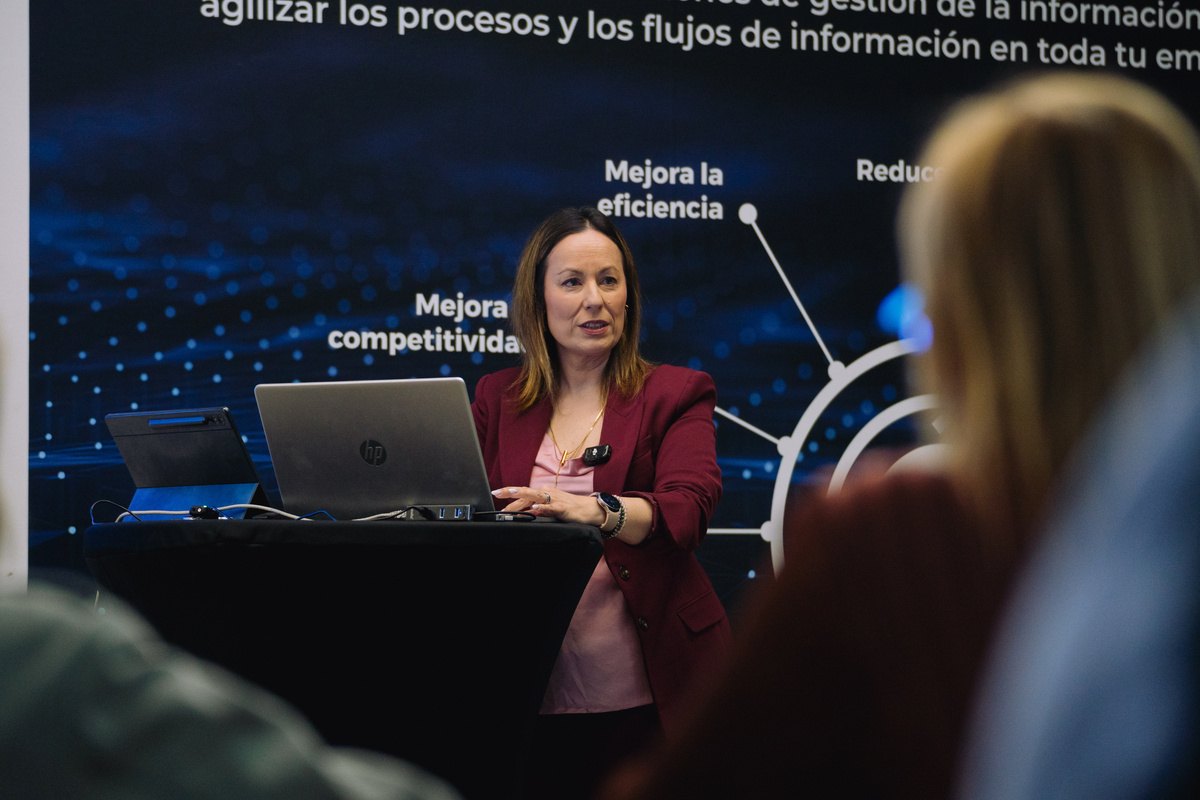
VÉRTIGO 2026 is the conference on artificial intelligence, cybersecurity and data protection organised by Iria Álvarez and Javier Cancelas, of Eritia Privacidad. Its motto sums it up well: technology without fear, to move forward with good judgement.
- When: Thursday 10 December 2026, from 9:00.
- Where: Círculo de Empresarios de Galicia, Avenida de García Barbón, 62, Vigo.
- Who it's for: business decision-makers. No technical knowledge required.
- Topics: applied AI, data protection, cybersecurity, AI literacy and AI governanceAI GovernanceRegulatory and management framework for the responsible use of AI.
- Cost: nothing. In-person attendance is free with prior registration, and there will be an open live stream.
Almamark, Iria Álvarez's agency, is taking part in the conference, where Iria herself will present NAiOS. If you're in Galicia and want to see the platform and talk to the people who implement it, this is the best day to do it.

Where to start
You don't need to switch everything on the first day. Set-up starts with your email and calendar, and the other modules come in once the team has settled into the platform. If your business is in Galicia, get in touch with Iria Álvarez and her IACOBUS Assistant team: they'll tell you where to start based on your size and sector. If you'd rather look around on your own first, here are the plans. And if you want to see it in person, on 10 December Almamark presents NAiOS at VÉRTIGO 2026 in Vigo.
Where the figures come from
- Businesses by size, sector, province and municipality: Instituto Galego de Estatística, Directory of Businesses and Local Units, data as of 1 January 2024 (published 30 December 2025).
- Exports, weight of industry, GDP and population: CaixaBank Research, Galicia profile (March 2026), with data from 2024 and 2025.
- Milk, fishing fleet, canning and aquaculture: Mercasa, “Alimentación en España” (Food in Spain), Galicia chapter, with data from 2024.
- Forestry and timber chain: Xunta de Galicia, presentation of the 2025 forestry and timber chain report (May 2026).
- Maps: outline of Galicia from OpenStreetMap (© OpenStreetMap contributors).