
An advisory firm runs the fiscal life of dozens of companies on a mosaic of tools: one program for accounting, another for payroll, the tax calendar in a spreadsheet, client paperwork arriving by email and WhatsApp, case files in network folders. Every piece works; what does not work is the in-between: retyping, chasing documents, reconciling by hand. At NAiOS we built something else: the professional firm's complete cycle in a single system — with the client inside.
Mission control: the portfolio and a calendar that works alone
It all starts in NAiOS Gestoría: every client with their tax profile and a calendar that generates each period's filings by itself — portfolio traffic lights, alerts a week and a day before each deadline, receipts archived forever, and clients assigned per team member.
And now, the boxes: for the usual Spanish tax forms, the AEAT button opens the figures computed from the client's real numbers — bases and quotas per rate, deductible VAT, the result — reviewable and editable on screen, with the filing file ready for the tax agency. Direct telematic filing as a registered agent is already installed, with the house philosophy engraved in the product: it debuts in test mode, and real mode only unlocks after a filing accepted in the test environment. Without the advisor's explicit confirmation nothing is ever sent, and every attempt lands in a register that cannot be rewritten.
The monthly payroll cycle, properly closed
If the client manages their team in NAiOS RRHH (with time tracking included), the month closes in four steps: the monthly variations (hires, leavers, absences, hours) arrive by themselves on the 25th; payroll is processed in the usual payroll software — we do not compute payslips here, and we say so out loud —; the PDF batch is delivered to each employee with read receipts; and the new part: a CSV with the amounts (gross, net, employer social security, income tax) that in one minute puts the month's employer cost on each client's card and a "Payroll" line in their cash forecast.
What about computing payroll ourselves? Here is the part we enjoy telling: inside RRHH there is already a shadow payroll engine. It issues nothing — it computes in parallel and compares itself against the real amounts from the payroll software, concept by concept, with a streak of matching months and a target of six. Only if it matches for half a year on real payslips will we consider the next step. We prefer an engine that earns trust to one that asks for it.
Accounting that writes itself
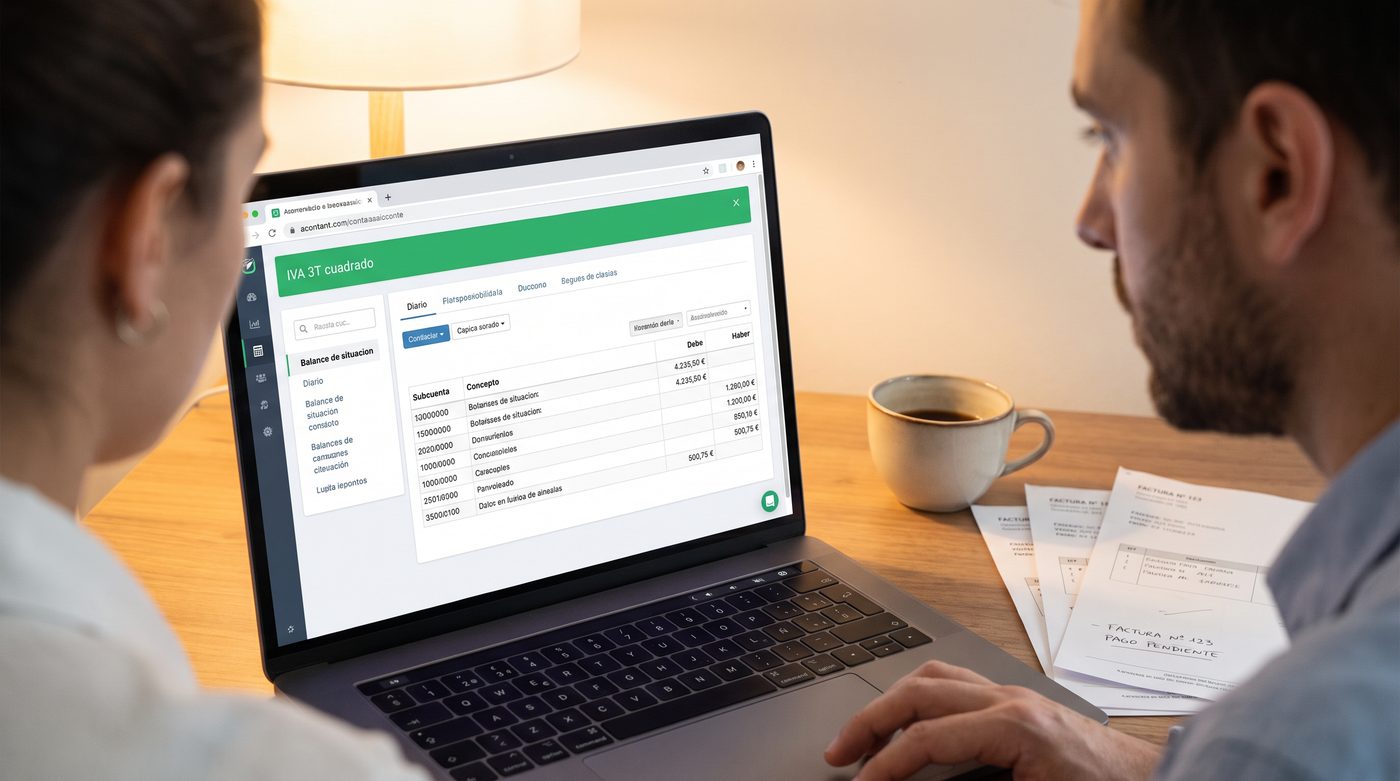
The missing piece: a full Accounting module on the Spanish chart of accounts, where the journal is generated. Every issued invoice, every expense and every payment reconciled in Treasury becomes its entry, with customer and supplier sub-accounts created automatically. Entries are born as proposals and are posted in batches after review; posted means immutable, and correcting means a reversing entry — as it should be.
- General ledger with running balance, trial balance, P&L and balance sheet, on screen or exported to a sheet.
- Guided year-end closing: regularisation, closing and next-year opening, with preconditions that refuse to close loose ends.
- Analytics by dimension with expenses auto-tagged by supplier, and fixed assets with exact monthly depreciation.
- A3 / ContaPlus export to coexist with the incumbent program during the transition.
Our favourite sanity check: the output-VAT account balance against the quarter summary in Gestoría. It reconciles to the cent by construction — both read the same numbers, not two copies.
The client portal: the client finally inside
It was the most requested piece and it changes the whole relationship. On any client's card there is a "Client portal" button: you invite them by email and they open their free account on that very page, in two clicks. From then on:
- You request documents and they upload them from their phone. Each file stays in quarantine until someone at the firm validates it; a rejection carries the reason and they upload again. A validated document with a destination lands by itself in the case file.
- They see the state of their affairs — only what you switch on, toggle by toggle: their tax traffic light (never amounts or fees), the phase of their cases (never the restricted ones, nor hours, nor rates), their invoices, pending signatures and your booking link.
- Nothing is visible by default, and if an access is revoked, their blocks switch off on their own. Professional secrecy lives in the design, not in trust.

Case files, deadlines, bills — and getting paid
For firms that also run legal matters, NAiOS Despacho brings case files with an immutable log, deadlines with a double key (the engine computes business days and shows its working; nothing alerts until a human confirms), conflict-of-interest checks and billing that drops the invoice draft into the ERP. Money closes the loop: invoicing with VeriFactu built in, signed e-invoicing under Spain's Crea y Crece law, optional FACe for public-sector clients, and reconciled treasury with a 30/60/90-day forecast.
Three ways to use it
The tax-accounting firm loads its portfolio, lets the calendar generate the periods, files with the computed boxes as reference and hands each client a portal for recurring paperwork.
The payroll bureau receives variations on the 25th, distributes the payslip batch with receipts, imports the amounts in a minute and sees each client's employer cost — while the shadow engine accumulates months of parallel running.
The legal-economic firm runs insolvency and inheritance matters in case files with confirmed deadlines and access restrictions, collects documentation through the portal, bills from the case file and invoices with its own series.
The fine print that defines us
Everything delicate shares three rules: nothing leaves without human review; sensitive steps debut behind measured locks (test mode before real mode, parallel running before issuing); and what it does not do yet, it says — BETA labels and honest notices are part of the product. That is how a platform earns a firm: no smoke.
Getting started takes five minutes
The portfolio loads in an afternoon, the tax calendar generates itself and the first client portal goes out in two minutes. For the full picture of the platform, start with why NAiOS — and if you run an advisory or professional firm, talk to us: this suite is being built with real firms, and it shows.