WAICO: The new Chinese AI alliance and its impact on European SMEs
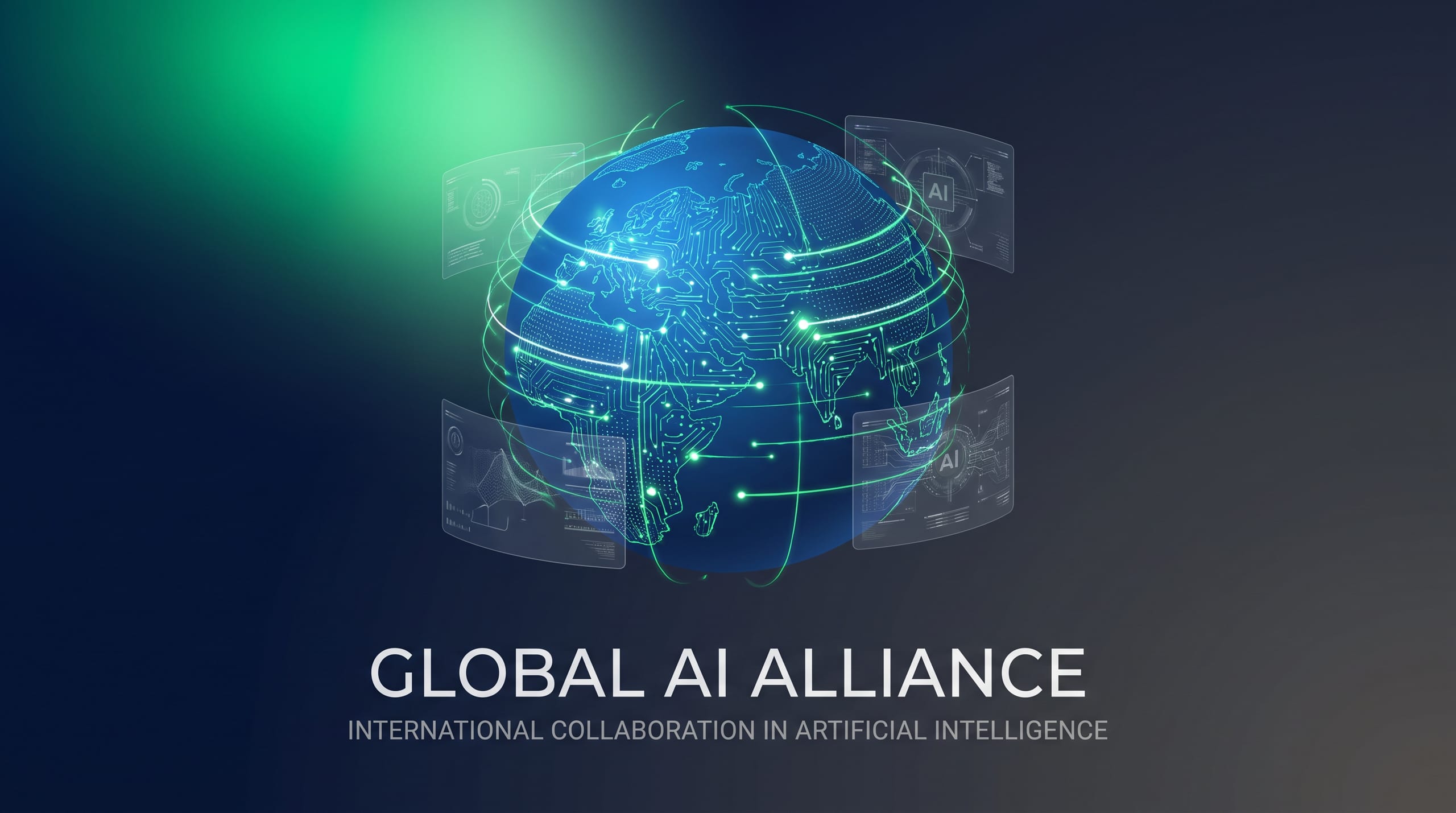
The geopolitical landscape of technology has undergone a seismic shift. Between July 12 and July 27, 2026, the global ecosystem of Artificial Intelligence witnessed the birth of a new giant: the World Artificial Intelligence Cooperation Organization (WAICO). Signed in Shanghai by 29 countries, this intergovernmental organization led by China marks the beginning of an era of profound technological fragmentation.
For large multinationals, this poses a diplomatic and corporate challenge. However, for European SMEs, the creation of WAICO and the growing technological polarization represent a direct threat to their competitiveness, operational costs, and medium-term viability.
In this article, we will analyze what WAICO is, the real risk of cross bans on AI models, the consequences for European SMEs, and, most importantly, how your company can shield itself against this geopolitical chaos by using agnostic operating systems like NaiOS.
What is WAICO and what exactly has happened?
On July 16, 2026, 29 nations ratified the founding agreement of WAICO. Its official objectives are to promote international cooperation, capacity development, and establish global governance of AI.
But what defines WAICO is not who is inside, but who has been left out: no member state of the European Union, nor the United States, nor any Western democracy from the G7 is participating. The core is formed by China, countries from Central Asia, Africa, the Middle East, Latin America, and geographical European allies such as Russia, Belarus, and Serbia.
During the World AI Conference in Shanghai, China not only signed papers; it put an overwhelming soft power on the table:
- 5,000 training spots on AI for developing countries.
- International cooperation centers with ASEAN, the African Union, BRICS, and CELAC.
- Investments in smart computing infrastructure worth billions of dollars.
WAICO is, for now, a diplomatic platform. But its long-term goal is clear: to offer the Global South a technological and regulatory alternative that directly competes with the standards of Silicon Valley and Brussels.
The risk of a "Digital Iron Curtain": Bans and blockades
One of the biggest concerns arising from the consolidation of WAICO is the possibility of cross bans between blocs.
What would happen if the European Union, under the AI Act and data protection (GDPR), decides to ban the use of AI models developed in China, considering them a risk to national security or fundamental rights?
China's response would be immediate: a symmetrical ban on European technologies in WAICO member countries. This scenario of "digital cold war" would leave thousands of European SMEs caught in the crossfire. If your company has integrated a Chinese language model (LLMLLM (Large Language Model)Large language model, the foundation of today's chatbots) due to its low cost, a European blockade would paralyze your operations overnight. Conversely, if you attempt to export your European AI-based services to emerging markets under WAICO's influence, you could find yourself facing insurmountable entry barriers.
5 Negative Consequences for European SMEs
The creation of this new geopolitical bloc is not just a news headline; it has direct repercussions on the bottom line of small and medium-sized enterprises in Europe.
1. Regulatory Fragmentation and Increased Costs
SMEs will have to navigate three incompatible regulatory spaces:
- European Union: Risk-based approach, fundamental rights, and the strict AI Act.
- WAICO / China: State sovereignty-focused approach, data control, and rapid development.
- United States: Emphasis on national security and supply chain control.
Adapting software and services to each jurisdiction will multiply compliance costs, something that SMEs can hardly afford.
2. Fierce Competition from "Low-Cost" Models
China is flooding the market with open and extremely cheap AI models. If these models become standardized across the 29 WAICO countries, European SMEs in software, customer service, translation, or data analysis will face brutal pressure on their prices. Competing on cost will be impossible; Europe will have to compete on trust and security.
3. Loss of Emerging Markets
China offers a "full package" to developing countries: AI models, financing, data centers, and telecommunications networks. European SMEs operating in Latin America, Africa, or Central Asia could lose bids and clients as they cannot compete against this ecosystem subsidized by the Chinese state.
4. Risk of Technological Dependence (Vendor Lock-in)
Building the technological core of your SME on a foreign API (whether American or Chinese) is a risky endeavor today. If there is a regulatory change, a trade blockade, or a unilateral price increase, your company will be paralyzed.
5. The Nightmare of AI Act Compliance
Using a cheap Chinese model does not exempt you from European law. If your SME uses a WAICO model to operate in Europe, you are the legal responsible party for ensuring compliance with the AI Act (transparency, human oversight, cybersecurity). Auditing an opaque foreign model can be technically and legally impossible for a small or medium-sized enterprise.
The map of technological fragmentation
Next, we illustrate how the new ecosystem is divided and how a layer of abstraction can save your company:
B -. Risk of Prohibition .- D
D -. Risk of Prohibition .- B

E[NaiOS: Agnostic Operating System] -->|Secure Connection| B
E -->|Secure Connection| C
E -->|Secure Connection| D

F[European SME] -->|Unique Integration| E

style F fill:#4CAF50,stroke:#388E3C,stroke-width:2px,color:#fff
style E fill:#2196F3,stroke:#1976D2,stroke-width:2px,color:#fff
style B fill:#FFC107,stroke:#FFA000,stroke-width:2px
style C fill:#FFC107,stroke:#FFA000,stroke-width:2px
style D fill:#FF5722,stroke:#E64A19,stroke-width:2px,color:#fff
The ultimate solution: NaiOS, the independent operating system
In this landscape of uncertainty, prohibitions, and suffocating regulations, the worst decision a European SME can make is to tie itself to a single Artificial Intelligence provider.
This is where NaiOS comes in.
NaiOS is an Artificial Intelligence operating system designed to insulate your company from geopolitical warfare. It acts as an intelligent abstraction layer between your data, your business processes, and the underlying AI models.
Why is NaiOS the salvation for European SMEs?
- Total Agnosticism: NaiOS does not depend on OpenAI, nor on Chinese models, nor on a specific European provider. You are free to use the engine that best fits each task.
- Immunity to Bans: If tomorrow the EU bans the use of a Chinese model you were using, with NaiOS you only need to click to switch to an equivalent European or American model. Zero code rewriting. Zero downtime.
- Integrated Regulatory Compliance: NaiOS helps you maintain data traceability and facilitates compliance with the European AI Act, regardless of the model you choose to use in the backend.
- Protection of Know-How: Your business data is never held hostage by the model provider. NaiOS acts as a protective shield that anonymizes and manages the flow of information.
In a world divided into blocks, agility and independence are your greatest competitive advantage.
Frequently Asked Questions (FAQ)
What is the WAICO alliance?
It is the World Organization for Cooperation in Artificial Intelligence, driven by China and formed by 29 countries from the Global South and allies, created to establish regulations and technological cooperation outside of the West.
Can Chinese AI models be banned in Europe?
Yes. There is a real risk that geopolitical tensions, combined with strict privacy requirements (GDPR) and the AI Act, could lead to blockages or bans on Chinese technology on European soil, and vice versa.
How does the AI Act affect my SME if I use WAICO technology?
The nationality of the provider does not matter.
What is NaiOS and how does it protect me?
NaiOS is an AI operating system that allows you to switch between AI models (European, American, or Asian) instantly and without touching your infrastructure, protecting your company from geopolitical blockages and technological dependencies.
Conclusion
The emergence of WAICO confirms that Artificial Intelligence has ceased to be just technology and has become pure geopolitics. European SMEs face a hostile environment marked by strict regulation, low-cost competition, and the imminent risk of cross-technology bans.
Do not leave your company's future in the hands of international tensions. It is time to adopt flexible, resilient, and agnostic architectures.
Protect your business's technological independence today. Contact us at info@netretina.ai and discover how NaiOS can safeguard your SME against the global fragmentation of AI.