
Claude Sonnet 5: The Agentic AI revolution is now available on Naios
The enterprise artificial intelligence landscape is advancing at a breakneck pace, and June 30, 2026, has marked a new milestone in this technological race. Anthropic has officially presented Claude Sonnet 5, the most agentic model in its history. This new iteration not only redefines what mid-sized language models can achieve, but also democratizes access to complex reasoning capabilities and autonomous task execution.
But the best news for the corporate sector is not just the launch of the model itself, but its accessibility. At Naios, we are proud to announce that Claude Sonnet 5 is now fully integrated into our platform, joining our robust ecosystem that already includes the latest versions of OpenAI's GPT models, Google's Gemini, and many others.
In this article, we will break down all the new features that Claude Sonnet 5 brings, how it compares to its predecessors, and why using it through Naios is the smartest strategic decision for your business.
Context and Positioning: The leap toward autonomy
To understand the magnitude of this launch, we must look back. Anthropic notes that the era of agentic AIAgentic AIAI capable of planning, deciding, and acting autonomously (systems capable of acting autonomously to achieve goals) began for many developers with the Sonnet family (versions 3.5, 3.6, and 3.7). However, until recently, the most substantial improvements in agentic capabilities had been reserved almost exclusively for the Opus family, the company's largest, heaviest, and most expensive models.
With Claude Sonnet 5, this gap narrows drastically. The new model has been specifically designed to plan strategies, use external tools such as web browsers and command terminals, and operate autonomously in multi-step workflows.
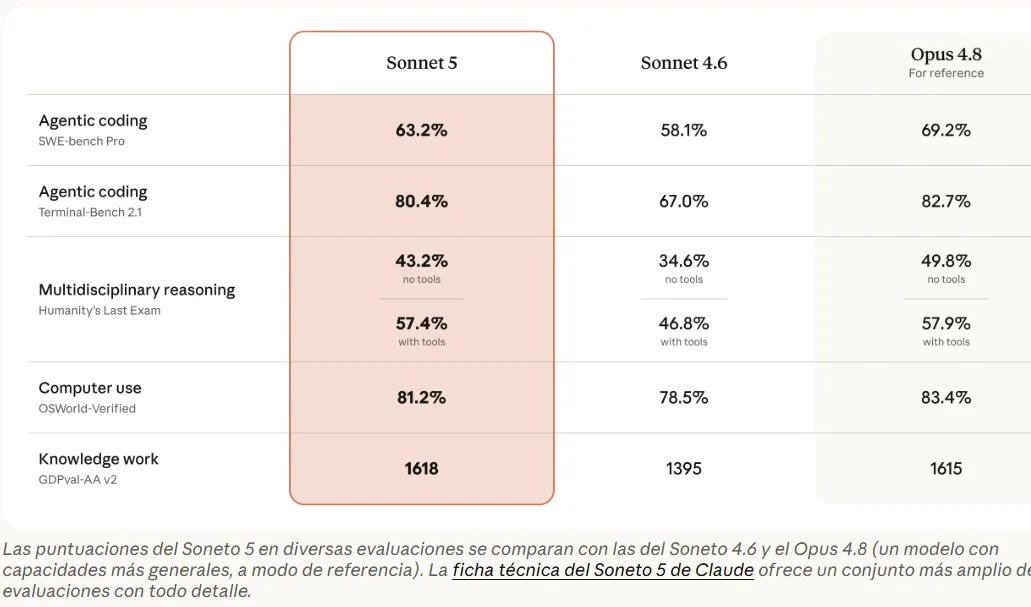
Its performance impressively approaches that of Opus 4.8, but maintaining a much lower cost structure. Compared to its direct predecessor, Sonnet 4.6, version 5 presents notable improvements in critical areas for businesses:
Advanced logical reasoning.
Precise use of third-party tools (Tool use / Function calling).
Programming and software development.
Knowledge work and complex data analysis.
Cutting-edge performance and the new "Level of Effort"
Performance evaluations (benchmarks) confirm Anthropic's claims. In rigorous agentic tests such as BrowseComp (which evaluates autonomous search and navigation capabilities) and OSWorld-Verified (which measures the AI's ability to use a computer as a human would), Sonnet 5 consistently outperforms Sonnet 4.6.
One of the most notable innovations in this version is the introduction of an adjustable parameter known as "effort level" (effort). This functionality allows users and developers to dynamically balance cost and performance. By setting the effort level to maximum, Sonnet 5 matches Opus 4.8's performance in several cases, offering a much broader and more flexible range of cost-performance options for businesses.
Success stories and early testimonials
Several partner companies have already put Claude Sonnet 5 to the test in real production environments, highlighting its reliability:
Salesforce workflows: Automation of complex CRM workflows without human intervention.
Rust and Lovable engineering teams: Advanced assistance in software coding and debugging.
Legal and insurance tools: Autonomous analysis of contracts and policies.
ClickHouse: Query optimization and database management.
The consensus among these partners is clear: Sonnet 5 is capable of completing multi-step tasks without stopping halfway and, most impressively, reviews and corrects its own work without the user having to explicitly ask for it, all at a highly competitive price.
Naios: Your Central Hub for Claude Sonnet 5, GPT, Gemini and more
In today's ecosystem, tying your company's technological infrastructure to a single AI provider is an unnecessary risk. Each model has its strengths: some shine in creative writing, others in programming, and models like Claude Sonnet 5 excel in agentic execution.
This is where Naios transforms the way you work.
Our platform already includes Claude Sonnet 5 natively, along with all the other leading models on the market (such as OpenAI's GPT family, Google's Gemini, and high-performance Open Source models). By using Naios, your company gains:
Unified access: A single interface and API to interact with any model.
Intelligent routing: The ability to delegate specific tasks to the model that best (and most economically) solves them.
Total flexibility: If a superior model emerges tomorrow, you'll have it available instantly in Naios without having to rewrite your code or switch platforms.
Advanced Security and Alignment
Enterprise adoption of AI requires strict security guarantees, and Anthropic has always excelled in this regard. Internal and external safety evaluations show that Sonnet 5 has a much lower overall rate of undesirable behaviors compared to Sonnet 4.6.
In agentic contexts (where the AI makes decisions on its own), Sonnet 5 has proven exceptionally safe. It includes better refusal of malicious requests and greater resistance to hijacking attempts through prompt injectionPrompt InjectionAttacks that manipulate AI by inserting malicious instructions, a critical vulnerability in autonomous assistants.
Furthermore, the model records significantly lower rates of hallucinations (inventing information) and sycophancy (flattery or the tendency to agree with the user even when they are wrong).
Cyber Capabilities
An important point to highlight is Anthropic's stance on offensive cybersecurity. Claude Sonnet 5 was not deliberately trained on offensive cybersecurity tasks. Although it is perfectly capable of performing routine and non-harmful defensive cyber tasks, its performance on dangerous tasks (such as exploit development) is substantially inferior to that of specific models like Mythos 5 or Opus 4.8.
In a specific stress test on Firefox browser vulnerabilities, Sonnet 5 never managed to develop a complete exploit. Even so, out of extreme caution, Anthropic has released this model with the same real-time cyber safeguards that protect the Opus 4.7 and 4.8 versions.
Availability, Pricing, and Technical Details
Claude Sonnet 5 is available from day one across all of Anthropic's plans (Free, Pro, Max, Team, Enterprise), as well as in Claude Code and the Claude Platform.
Developers can invoke it through the API using the identifier claude-sonnet-5.
Pricing Structure
To facilitate the transition, Anthropic has established an introductory price valid until August 31, 2026:
Input: $2 per million tokens.
Output: $10 per million tokens.
Starting September 1, 2026, the price will move to the standard rate:
Input: $3 per million tokens.
Output: $15 per million tokens.
The New Tokenizer
A crucial technical detail for developers is that Sonnet 5 uses an updated tokenizerTokenizationProcess of dividing text into units (tokens) that the model can process. This means that the same input text may translate into a higher number of tokens (between 1.0 and 1.35 times more, depending on the language and type of content). The previously mentioned introductory price has been specifically calculated so that the transition to this new tokenizer is practically cost-neutral for current users.
Additionally, rate limits have been increased across all platforms to accommodate the higher token consumption required by higher effort levels.
(Transparency note: The original version of the Anthropic announcement included a cost-performance chart for BrowseComp based on a methodology different from the standard one, which underestimated the actual performance of Sonnet 5. Anthropic has already corrected this chart and the associated text, confirming the model's superior performance).
Conclusion: The time to scale your AI is now
Claude Sonnet 5 establishes itself as a monumental update that brings maximum agentic performance at an accessible cost, prioritizing security and enterprise reliability. Its ability to plan, execute, and review complex tasks autonomously will mark a turning point in corporate productivity.
Don't get left behind in the agentic AIAI AgentsSystems that execute multi-step tasks without constant supervision revolution. At Naios, we offer you the ultimate platform to integrate Claude Sonnet 5, GPT, Gemini and the rest of the leading models under one roof. Simplify your infrastructure, optimize your costs and multiply your team's efficiency today.
Are you ready to implement the most advanced AI in your business processes?
Take the next step! Contact our experts by writing to info@netretina.ai and discover how Naios can transform your company.