Artificial intelligence (AI) has radically transformed the business landscape, automating processes, optimizing decisions, and generating content at an unprecedented speed. However, as AI models become more complex and autonomous, a critical concern arises: the need for control, ethics, and precision. This is where a fundamental concept comes into play: HITLHuman in the Loop (HITL)A design in which a person reviews or approves the relevant actions of an AI system before they take effect, or Human-in-the-Loop (Human in the Loop).
In this article, we will explore in depth exactly what HITL means, how it works in practice, and, most importantly, what its implementation entails globally, within Europe's strict regulatory framework, and in Spain's technological ecosystem.

What exactly does Human-in-the-Loop (HITL) mean?
The term Human-in-the-Loop (HITL) refers to a design and operation model for artificial intelligence in which human interaction is an integral and indispensable part of the process. Instead of allowing a machine learning algorithm (Machine Learning) to make decisions 100% autonomously from start to finish, the HITL approach ensures that a human intervenes at critical stages.
This human intervention usually occurs in three main phases of the AI lifecycle:
Model training: Humans label data, categorize information, and provide initial feedback. A clear example is RLHFRLHFReinforcement Learning from Human Feedback (Reinforcement Learning from Human Feedback), the technique that made models like ChatGPT so conversational and safe.
Tuning and validation: During testing, humans evaluate the model's results, correct errors, and adjust parameters to avoid hallucinations or biased responses.
Operation and decision-making (Inference): In critical systems, AI does not execute the final action but instead makes a recommendation. It is the human professional who reviews the suggestion and makes the final decision, assuming responsibility.
In summary, HITL combines the speed and massive data processing capacity of AI with human critical judgment, empathy, and contextual understanding.
The global impact of HITL: Beyond automation
Globally, the adoption of AI has generated a frantic technological race led by powers such as the United States and China. In this global context, HITL has evolved from being a simple training technique to becoming a corporate risk mitigation strategy.
Major global technology corporations have understood that letting AI operate without supervision can result in public relations disasters, massive financial losses, or, in the worst-case scenario, harm to people (for example, in medical misdiagnoses or autonomous driving).
Globally, HITL entails:
A quality standard: Companies that use HITL offer much more accurate and reliable AI products.
Safety and alignment: It ensures that AI systems act in accordance with human values and business objectives, avoiding unpredictable behaviors.
New jobs: Contrary to the belief that AI will destroy all jobs, the HITL approach is creating a massive demand for "AI trainers," algorithmic auditors, and data ethics supervisors worldwide.
HITL in Europe: The framework of the Artificial Intelligence Act (AI Act)
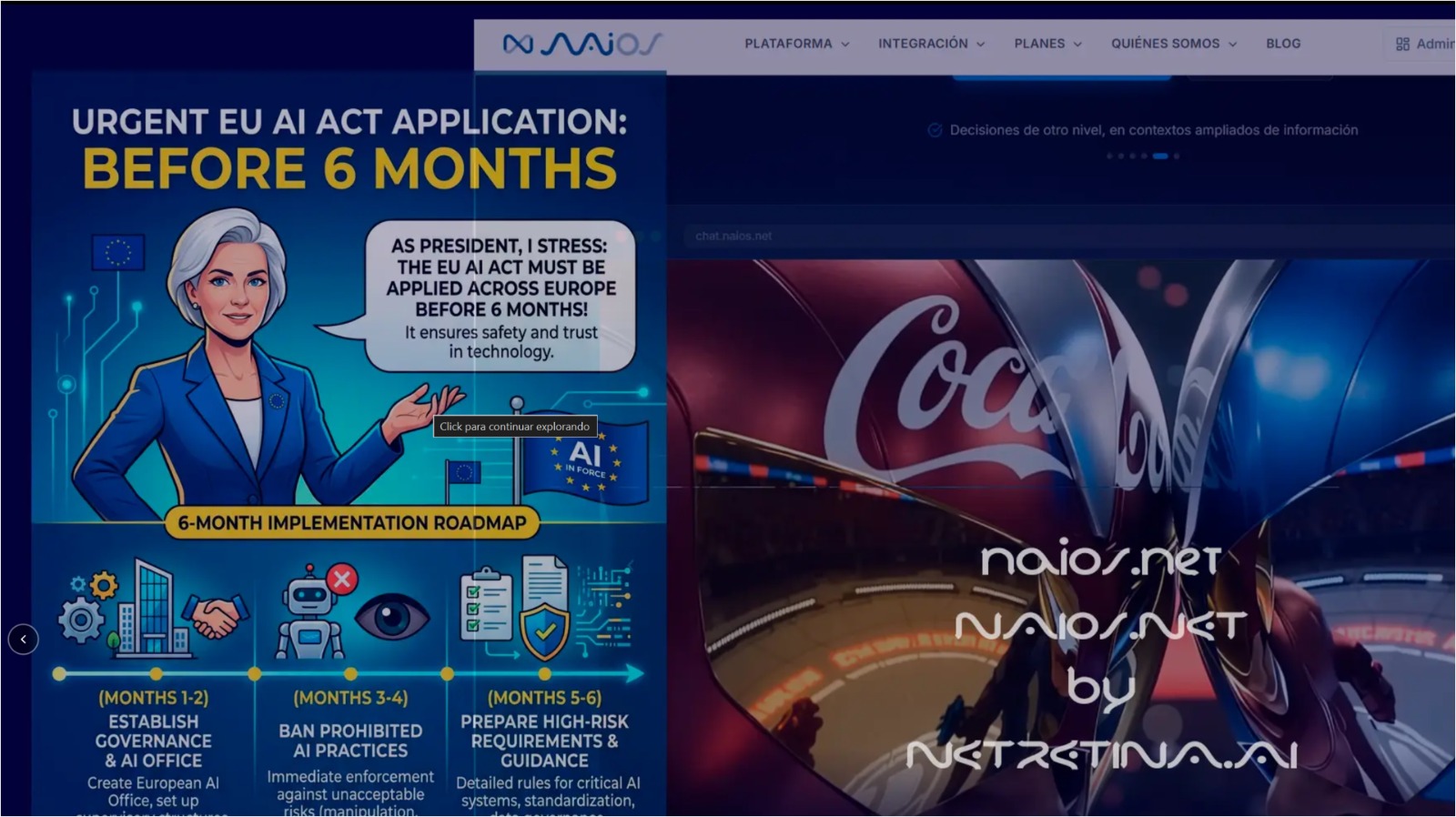
While HITL is seen as a good business practice globally, in Europe it has become a legal obligation. The European Union has taken the global lead in technological regulation with the recent approval of the Artificial Intelligence Act (AI ActAI Act (EU AI Act)Regulation (EU) 2024/1689: the first comprehensive law on artificial intelligence, with obligations based on risk level).
Europe has an approach deeply centered on fundamental rights and citizen safety. Therefore, European legislation classifies AI systems according to their risk level. For "high-risk" systems (such as those used in critical infrastructure, education, human resources, law enforcement, and administration of justice), the regulations are categorical.
What HITL entails in Europe is summarized in the following key points:
Mandatory human oversightHuman oversightAn obligation under the EU AI Act for trained individuals to be able to understand, monitor, and intervene in an AI system (Article 14): The AI Act explicitly requires high-risk AI systems to be designed in such a way that they can be effectively overseen by natural persons throughout their period of use. In other words, HITL is an unavoidable legal requirement.
Override capability: The human supervisor must have the ability to ignore, override, or reverse decisions made by the AI system (the famous "kill switch").
Transparency and traceability: European companies must be able to demonstrate to authorities how and when humans intervene in their algorithmic processes.
For companies operating in Europe, this means that AI adoption cannot be an exercise in blind automation. They must invest in user interfaces that allow for human oversight and train their staff to understand and audit AI decisions.

The scenario in Spain: AESIA and business adoption
Spain is not only a key player within the European framework, but it has also sought to position itself as a pioneer and benchmark in the oversight of artificial intelligence. Spain was the first European country to create a government agency dedicated exclusively to this purpose: the Spanish Agency for the Supervision of Artificial Intelligence (AESIA), headquartered in A Coruña.
What does the HITL approach mean for the technological and business ecosystem in Spain?
A regulatory testbed: Spain has promoted regulatory sandboxes (testing environments) where companies can test their AI systems under government supervision before launching them on the market. In these environments, demonstrating a solid HITL architecture is essential to getting the green light.
Protection for SMEs: The Spanish business fabric is mostly composed of small and medium-sized enterprises. For a Spanish SME, implementing AI can be risky if the system fails. The HITL model allows SMEs to adopt AI gradually and safely, keeping their human experts in command while the AI acts as a "copilotAI CopilotAI Assistant integrated into work tools" that increases productivity.
Ethical leadership opportunity: Spanish companies that adopt and certify their systems under human oversight (HITL) standards will have a huge competitive advantage when exporting their services to the rest of Europe, as they will de facto comply with the strictest regulations.

Strategic benefits of implementing HITL in companies
Whether for regulatory compliance in Europe or global business strategy, integrating humans into the AI loop offers tangible advantages for any organization:
Reduction of biasAlgorithmic BiasWhen AI reproduces or amplifies biases present in the data and discrimination: Humans can detect cultural, ethical, and social nuances that algorithms often overlook, avoiding discriminatory decisions in areas such as recruitment or credit granting.
Continuous model improvement (Active Learning): When a human corrects the AI in complex or ambiguous cases, that data is fed back into the system. This makes AI smarter and more accurate over time in a very efficient way.
Increased customer trust: In the B2B and B2C sectors, customers trust a service more if they know there is a human expert validating critical decisions, especially in sectors such as finance, healthcare, and legal.
Adaptability to exceptions: AIs are excellent at handling the norm, but fail miserably at the exceptional (so-called edge cases). The human in the loop is the perfect lifesaver for managing anomalous situations that were not in the training data.
Conclusion: The future is collaborative, not substitutive
The concept of Human-in-the-Loop demystifies the narrative that artificial intelligence is coming to completely replace humans. On the contrary, it demonstrates that the future of business technology lies in collaborative intelligence: machines providing scalability, speed, and massive data analysis, and humans providing context, ethics, responsibility, and critical judgment.
Globally, HITL is the quality assurance of AI. In Europe, it is the pillar of regulation that seeks to protect fundamental rights through the AI Act. And in Spain, under the watchful eye of institutions such as AESIA, it represents a golden opportunity to develop a competitive, secure, and deeply ethical technology industry. For any company looking toward the future, keeping the human in the loop is no longer an option; it is a strategic and legal imperative.