
The emergence of Artificial Intelligence has forever changed the way companies operate, communicate, and produce. However, as the adoption of these tools grows, so does a common frustration among executives and professionals: AI results are often mediocre, generic, or, in the worst cases, completely fabricated.
If you have ever asked ChatGPT or any other model to write a report and the result was disappointing, you are not alone. The problem is not that the technology is deficient; the problem lies in how we communicate with it. This is where the Karpathy Method comes into play, a revolutionary approach that proposes moving away from using AI with loose prompts and starting to work with it as if it were a rigorous engineering process.
In this article, we will discover what this method consists of, how you can apply it to successfully integrate AI into your company, and why it is the key to scaling productivity in your SME without losing quality control.
The real problem: The context gap and "Waterfall Mode"
To understand the solution, we must first analyze the problem. Most AI errors, hallucinations, and imprecise responses do not happen because "AI is bad." They occur due to what experts call a context gap.
As a user, you have a brilliant and detailed idea in your head about what you need. You know your company, your brand tone, your ideal customer, and the limitations of your sector. However, when you sit in front of the screen, you give the AI a minimal instruction, such as:
"Write a commercial proposal for a client in the logistics sector."
The AI receives only a tiny fraction of the information you need it to process. To fulfill your order, the model is forced to fill in the empty gaps. How does it do it? By inventing data, over-generalizing, or assuming incorrect premises.
This triggers the dreaded waterfall mode:
Excessive request: You ask for something very large and complex all at once.
Deficient result: The AI delivers a weak, generic first draft or one with errors.
Superficial correction: You try to fix it by asking it to change a couple of things.
Frustration loop: You correct again based on the previous error.
Patched final result: You end up with an inconsistent document that looks like a Frankenstein of disconnected ideas, and you have lost more time than you would have spent doing it yourself.
The Karpathy Method was born precisely as an anti-waterfall approach. Its goal is to work in small blocks, validated step by step and with a robust, accumulated context.
What is the Karpathy Method?
Inspired by software development best practices and the vision of AI experts like Andrej Karpathy, this method proposes a fundamental paradigm shift. It is not about asking the AI: "Make me a course", "write me a report" or "create a proposal".
It is about building a structured work environment where Artificial Intelligence has five fundamental pillars:
Context + Rules + Limits + Validation + Final review.
By applying this formula, we transform the AI from a simple "automatic text generator" into a highly specialized and supervised technical assistant.
The 3 Phases of the Karpathy Method
To implement this system in the day-to-day of your SME, you must follow a process divided into three clear phases.
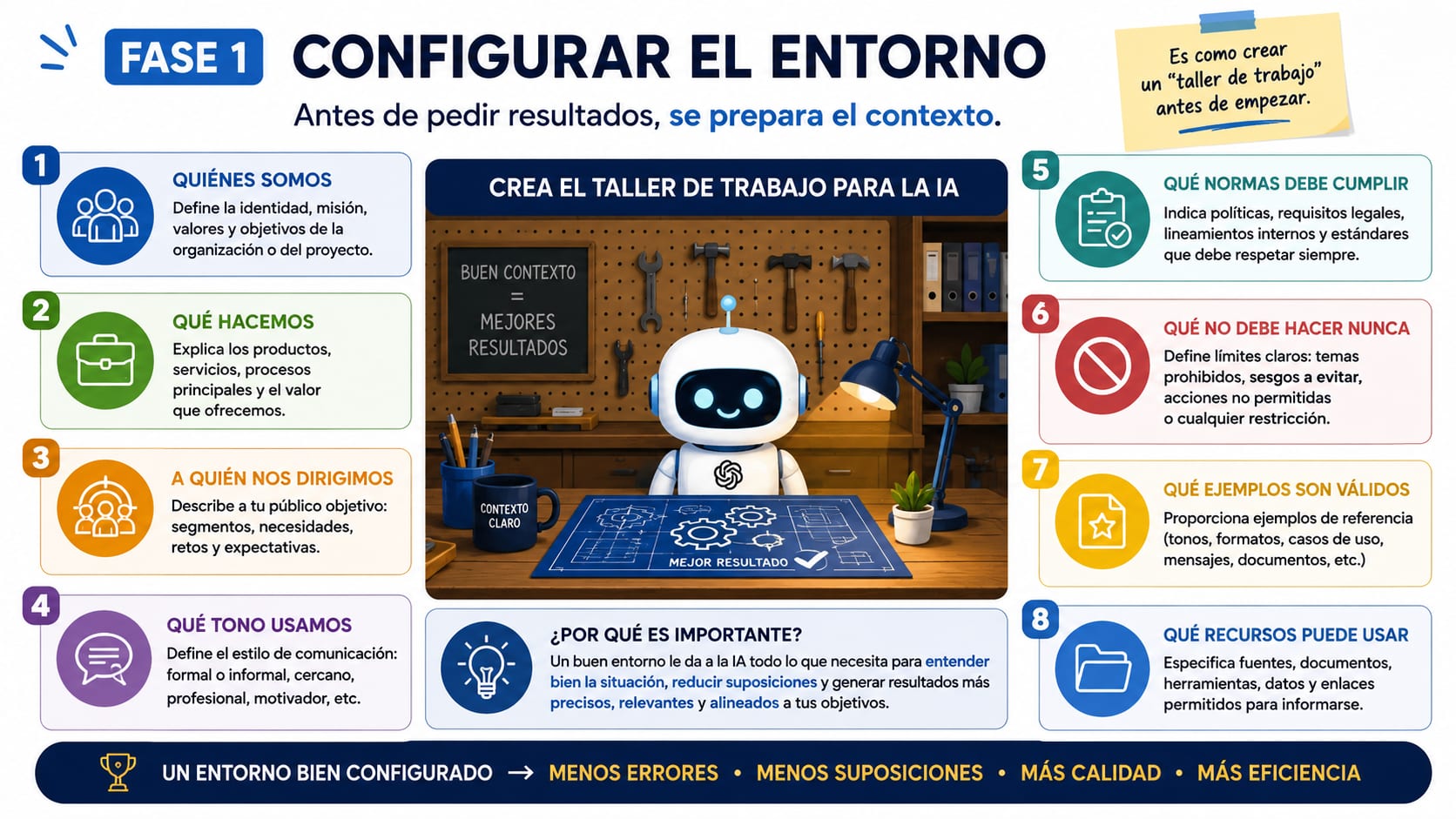
1. Setting up the environment (The Workshop)
Before asking for any result or execution, it is mandatory to prepare the ground. Imagine you have just hired a very intelligent external consultant who knows absolutely nothing about your company. Would you ask them to draft a contract in their first minute at the office? No. First, you would take them through an onboarding process.
In this phase, you must provide the AI with:
Identity: Who we are and what our mission is.
Activity: What we do exactly and what we sell.
Audience: Who we are targeting (our buyer persona).
Tone of voice: What communication style we use (formal, friendly, technical, persuasive).
Compliance rules: Which guidelines it must strictly follow.
Red lines: What it must NEVER do or say under any circumstances.
Examples (Few-Shot Prompting): Success stories or previous texts to serve as a reference.
Resources: What data, documents, or specific information it can use.
2. Applying the SPEC model (The AI takes control of the questions)
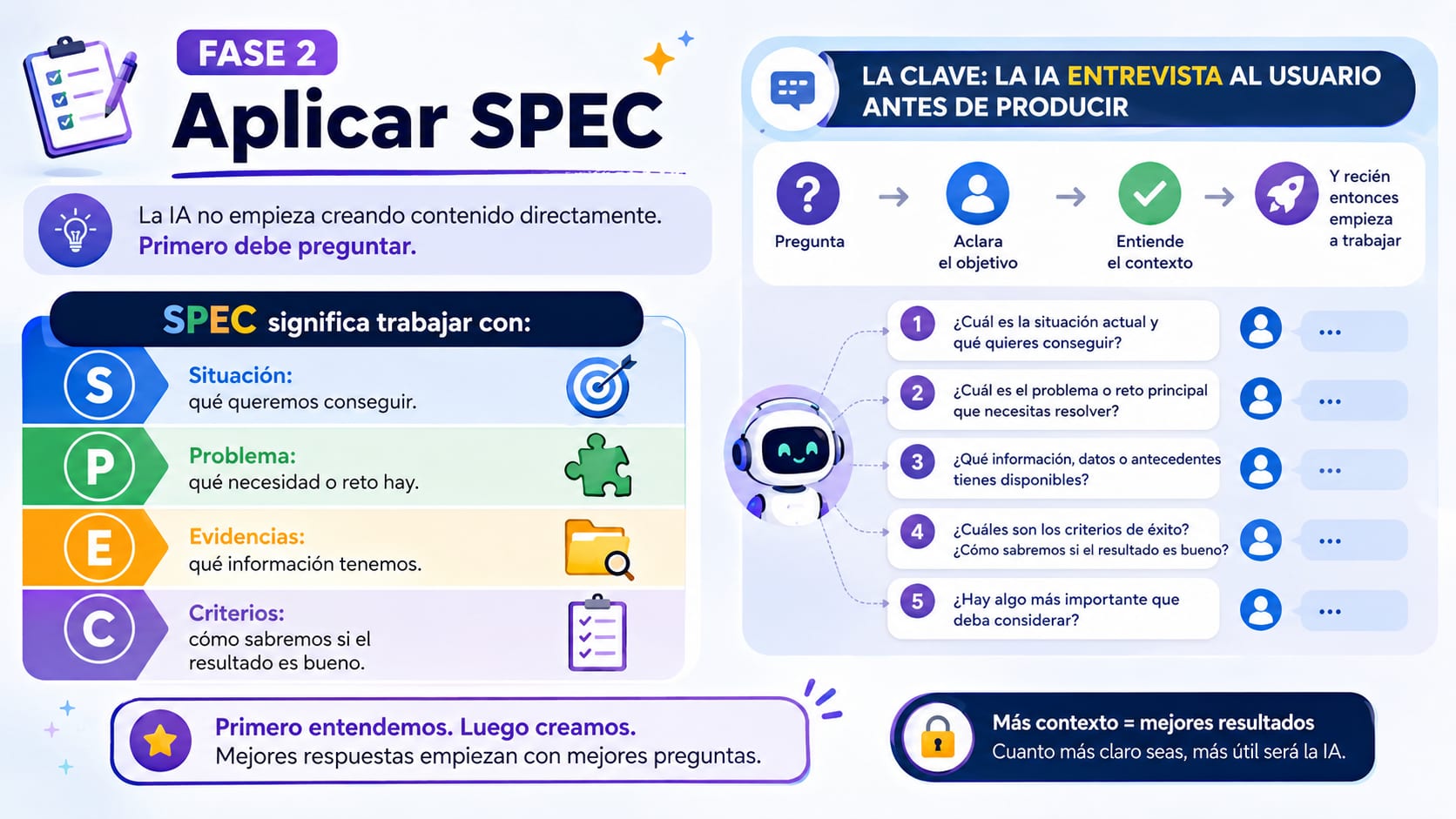
The biggest mistake in traditional AI use is believing that we must provide all the answers in the first prompt. In the Karpathy Method, the AI does not start by creating content directly. First, it must ask.
To do this, we use the SPEC framework, which forces the AI to analyze:
S (Situation): What we want to achieve or what the current state is.
P (Problem): What need, challenge, or pain point we are trying to solve.
E (Evidence): What information, data, or metrics we have at our disposal.
C (Criteria): How we will know if the final result is a success (quality KPIs).
The key to this phase is to command the AI to act as an interviewer. We ask it to pose 4 or 5 strategic questions to clarify the objective and refine the context. Only when we have answered those questions and the objective is crystal clear does the AI receive permission to start working.
3. Verification and Audit (Quality Control)
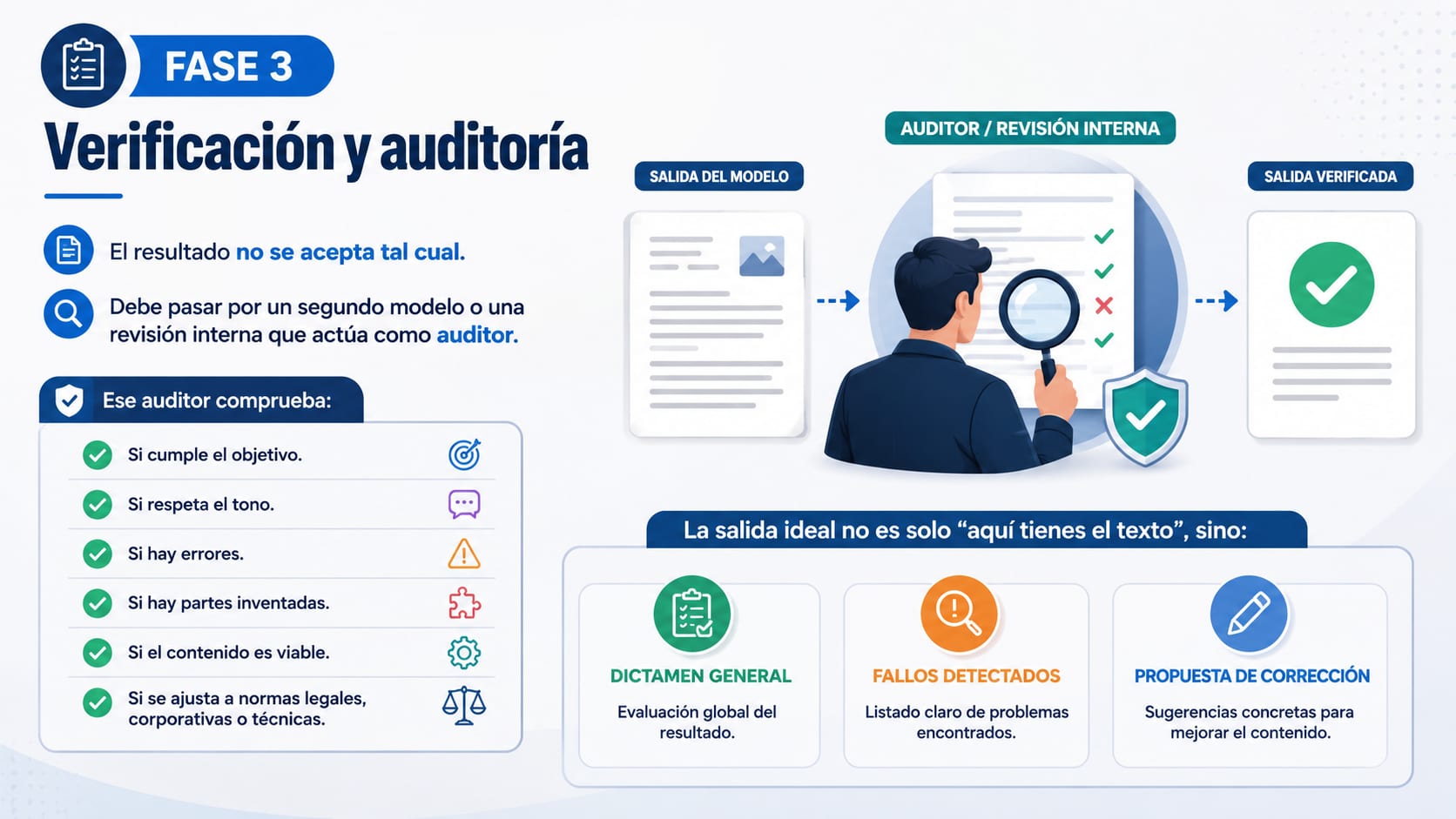
In a business environment, the first draft should never be the final one. The generated result is not accepted as is.
The Karpathy Method requires content to go through an audit process. This can be done using a second AI model (for example, using Claude to review what ChatGPT did) or by assigning the same AI a new role as a "Relentless Internal Auditor."
This auditor must check:
If the content meets the main objective.
If it respects the brand tone and established rules.
If there are logical, grammatical, or calculation errors.
If there are invented parts (hallucinations).
If the content is viable and realistic.
If it complies with legal, corporate, or technical industry regulations.
The ideal output of this phase is not simply the final text, but a detailed report that includes a general verdict, detected flaws, and a correction proposal.
How to apply it in your company: A practical example
The theory sounds great, but how does this translate into your company's daily work? Let's look at the difference between the traditional approach and the Karpathy Method.
The traditional approach (Waterfall Mode):
"Create an Artificial Intelligence training for my company's Human Resources department."
(Probable result: A generic, boring syllabus that doesn't take into account the tools your company uses or the technical level of your employees).
The Karpathy Method approach:
"Act as an expert in instructional design and AI adoption in corporate environments. I want to create an AI training for my HR department. First, interview me by asking 5 key questions to understand my audience, their current technical level, the desired duration of the course, the business objectives, and our technological limitations. Once I answer, propose only the course outline. Do not write the content until I approve said outline. When I give you the green light to write, do it block by block, waiting for my validation after each section. At the end of the entire process, assume the role of an expert auditor in corporate compliance and pedagogical clarity, and review all the material looking for errors, biases, or confusing concepts, providing me with a report of improvements before the final version."
Golden rules for mastering this method
For this system to work and transform the productivity of your SME, make sure to always follow these guidelines:
Context before action: Never ask for results without having prepared the work environment.
Divide and conquer: Never ask for huge tasks all at once. Work in blocks.
Force curiosity: Force the AI to ask you questions before generating answers.
Continuous validation: Approve each phase (e.g., the outline) before moving on to the next (e.g. the drafting).
Use your own data: Feed the AI with valid examples from your company.
Clear limits: Explicitly define what the AI should NOT do.
Separation of roles: Separate the creation phase from the review phase.
Tangible benefits for SMEs
Integrating the Karpathy Method into your company's workflows brings immediate competitive advantages:
Pinpoint accuracy: The result fits exactly what your business needs.
Zero hallucinations: By limiting uncontrolled creativity, invented data is drastically reduced.
Brand consistency: The AI understands and respects your business's tone and values.
Real time savings: Hours lost correcting poor texts are eliminated.
Regulatory compliance: It is much easier to ensure that content respects internal and legal regulations.
Scalability: Allows you to multiply the production of training, reports, proposals, and processes without losing quality control.
In which areas of your business should you apply it?
This AI process engineering method is especially powerful and recommended for high-value tasks, such as:
Creation of corporate training and design of internal courses.
Preparation of complex commercial proposals.
Content auditing and contract review.
Creation of custom GPT assistants for customer service.
Documentation of standard operating procedures (SOPs).
Generation of financial or performance reports.
Any work involving sensitive or regulated information.
Conclusion: Take the leap to professional AI
The Karpathy Method teaches us a fundamental lesson: the true value of Artificial Intelligence does not lie in its ability to give us quick answers, but in its potential to be integrated into a structured work system.
Let's remember the formula for success: Clear context + preliminary questions + block-based work + validation + final audit.
Applying AI well in your company does not mean learning to write longer prompts or using magic words. It means building the right conditions so that Artificial Intelligence thinks, creates, and reviews with the same criteria and rigor you would demand from your best employee.
Are you ready to leave basic prompts behind and start scaling your business intelligently? If you want to integrate AI into your company with proven and secure methodologies, contact info@netretina.ai.
Additionally, we invite you to take the first step today. Click on the following link and complete a free AI usage diagnosis for your SME: https://cutt.ly/St1ZWUTz. Discover where you stand and how you can start optimizing your processes as early as tomorrow.