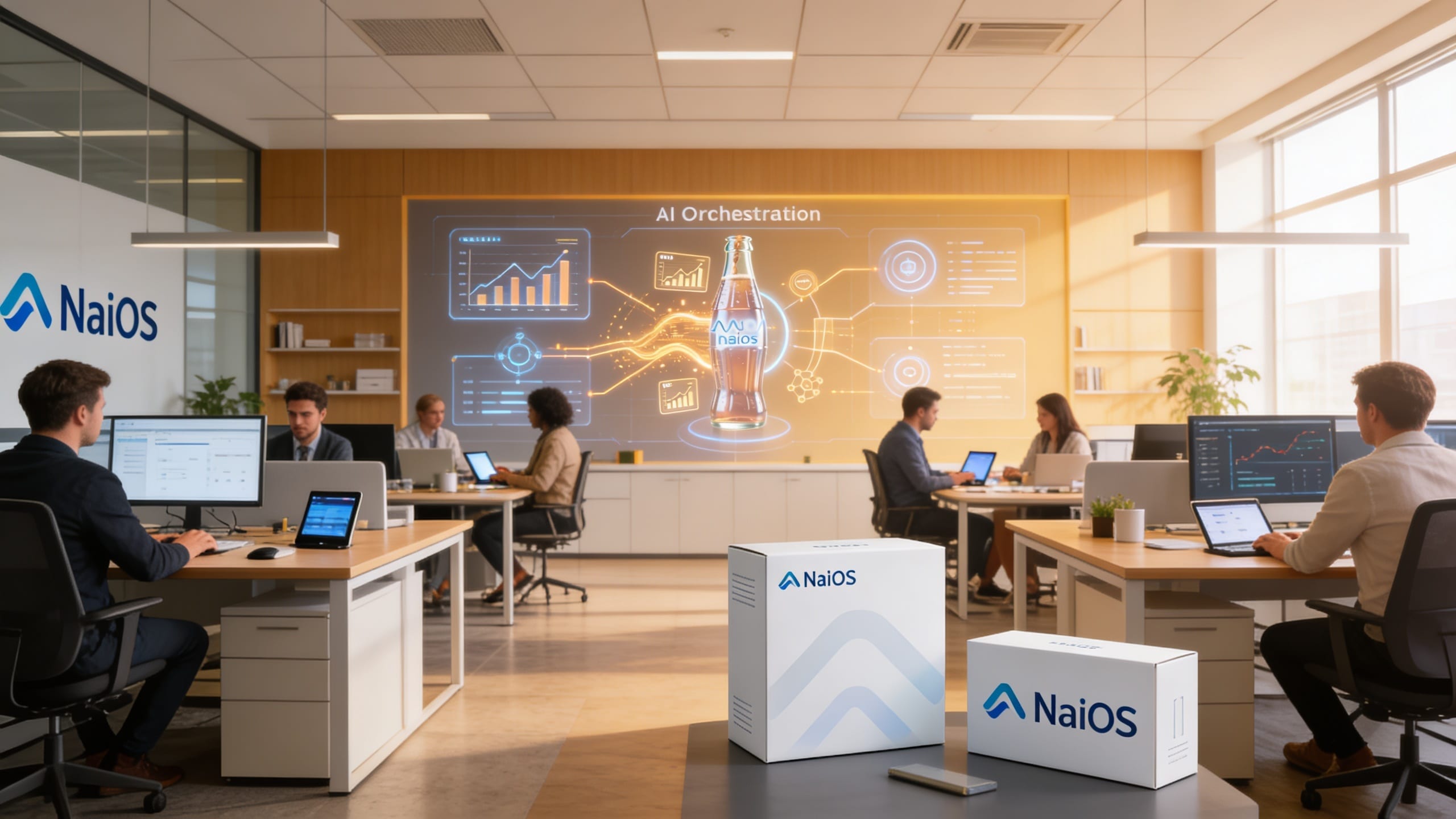
There is a phrase that made me stop in my tracks this week:
"The inventors of refrigeration made some money, but the real economic empire was built by Coca-Cola by using refrigeration to package, distribute, and globalize its product."
Read it again. Because it summarizes, better than any McKinsey or Gartner report, what is happening right now with artificial intelligence in the business world.
Over the last few years, we have been dazzled by the technical magic of large language models (LLMs). However, the history of technology teaches us a relentless lesson: the invention of a technical capability is rarely the final product. It is the distribution infrastructure that changes the world.
The inventors of cold in the digital age
OpenAI, Anthropic, Google, Mistral, DeepSeek… are the inventors of refrigeration in our era. They are building extraordinary technology and laying the foundations for a new industrial revolution. They will make money —a lot— and will go down in history as the pioneers who cracked synthetic reasoning.
But the real economic empire of this revolution will not be built by whoever manufactures the cold. It will be built by whoever knows how to package it, distribute it, and connect it with real life and the daily operations of companies.
Because refrigeration, on its own, sells nothing. It is a technical capability waiting for someone to turn it into a consumable, accessible, and scalable product.
The "empty fridge" syndrome: Why an LLM is not enough
The same applies to an Artificial Intelligence model. No matter how powerful GPT-5, Claude 3.5 Opus or Gemini Ultra may be, within a real company, a model in a vacuum is absolutely useless if:
- It doesn't talk to your ecosystem: If the IA cannot read your ERP (SAP, Oracle), your CRM (Salesforce, HubSpot) or your internal documentation, its responses will be generic and lacking corporate context.
- It has no governance or security: A raw model does not understand permissions, data traceability, or cost control. In a large company, sending confidential data to a public API without a security layer is an unacceptable risk.
- It doesn't integrate with your processes: If your employees have to leave their usual work tools to go to an external chat, adoption will fail.
- It is not agnostic: The AI market moves at breakneck speed. If you build your entire infrastructure on a single provider, what will you do when a better, faster, or cheaper model appears in six months?
The Coca-Cola strategy applied to AI: The NAiOS approach
That is exactly what we do at NAiOS. We do not compete to create the largest foundational model. What we do is take the best models in the world —more than 500 currently on the market— and we package, distribute, and globalize them within your company.
We connect them with your data, your legacy systems, your teams, and your processes. We govern them under strict corporate security standards. Ultimately: we make them useful.
We don't manufacture the cold. We manufacture the bottle, the cap, the delivery truck, the fridge in the corner bar, and the brand that makes someone want to open it. NaiOS is the orchestration layer that transforms an abstract technology into a profitability engine.
How is AI actually applied in your company with NaiOS?
To understand the value of distribution, we must look at real use cases. This is how orchestration transforms the "cold" into a refreshing drink for different departments:
1. Hyper-connected customer service
Instead of a generic chatbot that only knows how to answer FAQs, NaiOS allows you to connect an advanced LLMLLM (Large Language Model)Large language model, the foundation of today's chatbots directly to your CRM and ticket history. When a customer writes, the AI (using the most suitable model for that specific task) analyzes the customer's tone, reviews their previous purchases in the ERP, generates a hyper-personalized response, and even executes the refund or exchange action in the system, all under human supervision if necessary.
2. Financial analysis and report automation
Financial teams lose hundreds of hours cross-referencing data in Excel. By distributing AI internally, you can create autonomous agentsAgentic AIAI capable of planning, deciding, and acting autonomously that connect to your financial database. A manager can simply ask: "What was the variation in operating margin in Q3 compared to the previous year in the EMEA region?". The orchestration layer translates this into SQL queries, extracts the data, passes it through an analytical model, and returns a structured report with charts.
3. Knowledge Democratization (Advanced RAG)
Companies generate terabytes of knowledge that end up buried in SharePoint, Google Drive, or Confluence. Through Retrieval-Augmented Generation (RAGRAG (Retrieval Augmented Generation)Combine real data search with text generation) techniques, NaiOS packages AI to act as a corporate semantic search engine. A new engineering employee can ask how a specific bug was resolved in 2022, and the AI will retrieve the exact documents, summarizing the solution and citing internal sources.
4. Multi-Model Autonomous Agents
Not all tasks require the most expensive model. NaiOS allows for intelligent request routing: simple email classification tasks can be sent to fast and economical models (like Llama 3 or Claude Haiku), while the drafting of complex legal contracts is automatically routed to GPT-4o or Claude Opus. This optimizes performance and drastically reduces computing costs.
The defensive moat: Why orchestration is urgent
And here is the ultimate historical lesson: Coca-Cola did not win the soda war by having the best secret formula. It won by building the most efficient distribution layer on the planet. An infrastructure so well-designed and capillary that, once installed, it was practically impossible for competitors to unseat.
The enterprise AI orchestration layer is being built right now. And it is going to have exactly the same dynamic in the corporate world. It generates profound internal network effects: the more integrations you accumulate, the more embedded corporate knowledge you have in the system, and the more trained your teams are in using these integrated tools, the greater your competitive advantage will be.
The longer a company takes to start building its AI distribution layer, the harder it will be to catch up with those who started earlier. The productivity gap will become insurmountable.
Frequently Asked Questions (FAQ) about AI Orchestration
What is the difference between an AI model (LLM) and an orchestration platform?
An AI model (such as GPT-4) is the "brain" that processes and generates language. An orchestration platform (such as NAiOS) is the "nervous system" that connects that brain with company tools (databases, software, APIs), manages security, controls which user can see what information, and allows for switching "brains" without breaking the infrastructure.
Why not just use the Enterprise versions of ChatGPT or Claude?
Although they are excellent tools, they tie you to a single provider (vendor lock-in) and their closed ecosystem. A true orchestration layer is agnostic: it allows you to use OpenAI for marketing, Anthropic for programming, and local Open Source models for highly sensitive financial data, all from a single centralized platform.
How does NAiOS handle data privacy and security?
Orchestration allows for the establishment of strict governance policies. Your company's data is not used to train public models. Additionally, NAiOS manages Role-Based Access Control (RBAC), ensuring that a marketing employee cannot use AI to query human resources payroll data, even if both use the same platform.
What happens when a more advanced AI model is released to the market?
That is the greatest advantage of NAiOS.
If a revolutionary model is launched tomorrow that surpasses all current ones, you can integrate it into your corporate workflows with a couple of clicks, without the need to rewrite integrations, retrain your team, or migrate your data.
Conclusion: The question that will define your future
We are at a turning point. The base technology already exists and is amazing. The models are the refrigeration. NAiOS is the Coca-Cola.
If you lead digital transformation, operations, or your company's technology strategy, you must change the focus of your Artificial Intelligence strategy today.
The question you should be asking yourself today is not which AI model do I use?
It is: who is going to package, distribute, and globalize AI within my company?