In today's business landscape, Artificial Intelligence (AI) has ceased to be a technology exclusive to large tech corporations to become an accessible, democratized, and absolutely necessary tool for the survival of small and medium-sized enterprises (SMEs). It is increasingly common to read success stories and case studies on how AI is capable of automating tedious tasks, drastically improving customer service, optimizing supply chains, and multiplying profitability. However, in this frantic race to adopt the latest generative tools and predictive algorithms, many SMEs are making a critical strategic error: completely ignoring the quality of the raw material that feeds these technologies. We are referring, of course, to data.
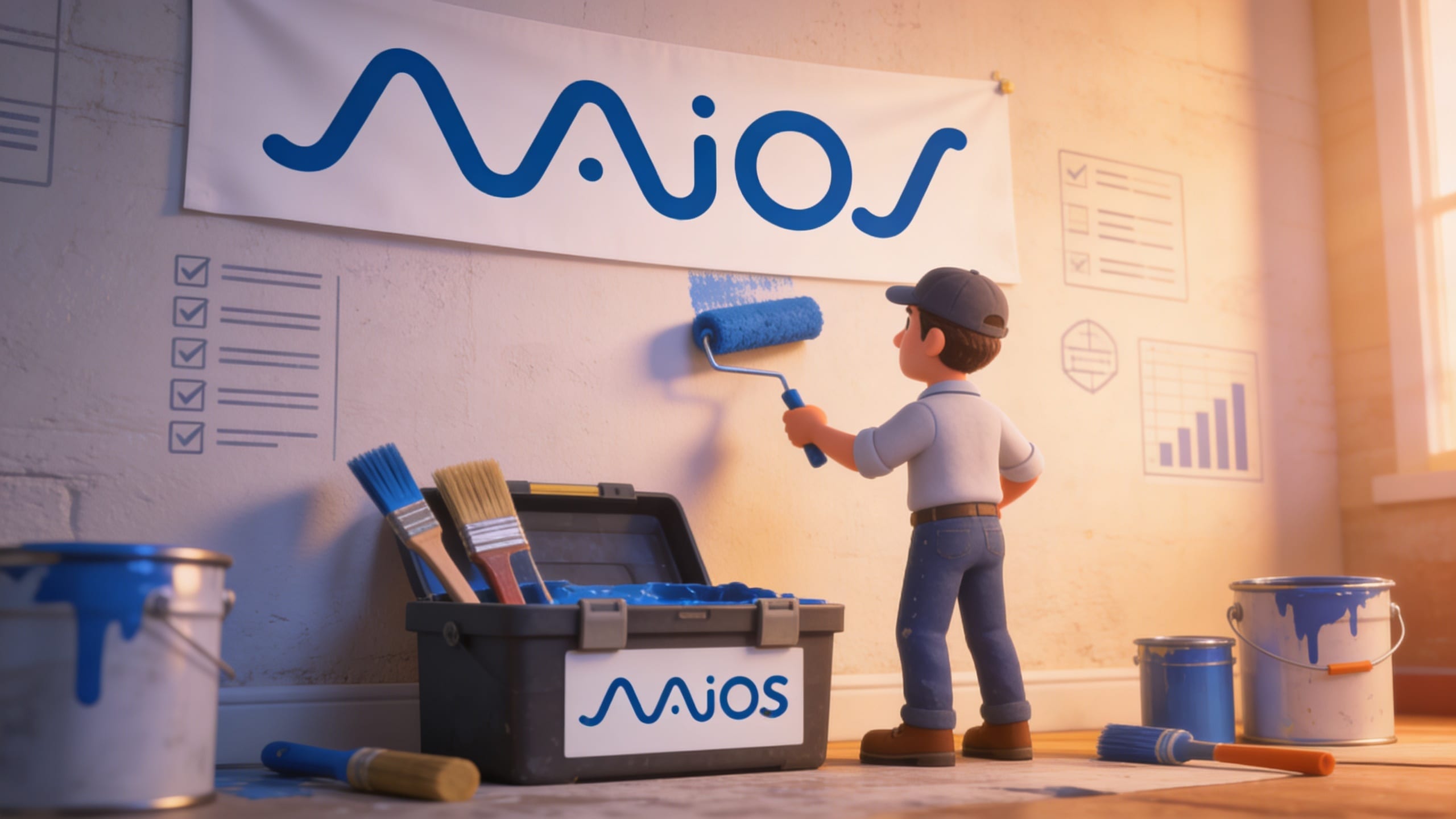
To understand the magnitude of this error, we can use a highly visual metaphor. Imagine for a moment a professional painter who has been hired to completely renovate the main living room of an old house. The homeowner, very excited, has bought the most expensive, exclusive, and highest quality paint on the market, expecting to achieve a spectacular and modern finish. But what would happen if the painter simply opens the can and starts applying that premium paint directly onto a wall full of deep holes, cracks, damp stains, and remnants of old wallpaper?
The result, obviously, would be a total disaster. The paint, no matter how good, expensive, or innovative it is, does not have the capacity to hide the structural defects of the wall; in fact, it is most likely to highlight them even more. A true painting professional knows perfectly well that the real work does not start with the brush. Before applying the first stroke, they must first fill the holes with putty, let it dry, thoroughly sand the wall so it is perfectly smooth, clean all the accumulated dust, and finally, apply a good coat of primer. Only at the end of all this laborious preliminary process does the painter paint.
In the complex world of business technology and digital transformation, Artificial Intelligence tools are that luxury paint, and your SME's historical and daily data are the wall. Data governance is, precisely, that indispensable process of filling the holes, sanding down the rough edges, and preparing the surface.
What is Data Governance and why is it non-negotiable before AI?
Data governance (or Data Governance) is nothing more than a set of processes, roles, policies, standards, and metrics that ensure the effective and efficient use of information to enable an organization to achieve its objectives. In simpler terms: it is about bringing order to your company's digital chaos to ensure that information is accurate, secure, available, and usable.
If an SME decides to implement Artificial Intelligence tools on a disorganized database, with duplicate records, incomplete information, or outright errors, the result will be what has been known in the field of computing for decades as "Garbage in, Garbage out." If you feed an algorithm with poor data, AI predictions will be inaccurate, automations will fail miserably, bad business decisions will be made, and ultimately, the investment of money and time will not yield a return.
3 Fundamental Steps to Prepare Your Data Before AI
To prevent your AI project from failing before it even starts, it is vital to establish a governance framework. Here we detail three essential steps that every SME must take:
1. Audit and Diagnosis: Plugging the holes
The first step is to understand the reality of your current situation. Many SMEs suffer from "data silo" syndrome: the sales department uses a CRM, accounting uses a different ERP, and marketing has information scattered across dozens of Excel spreadsheets.
You must conduct a complete audit to identify where your data is, who generates it, and what state it is in. It is time to identify the holes in your wall: Are emails missing from customer files? Are there incomplete purchase histories? Are there discrepancies between what the billing software and the inventory software say? Locating these deficiencies is the indispensable first step to being able to fix them.
2. Cleaning and Standardization: Sanding the wall
Once the problems have been identified, it's time to roll up your sleeves and clean. This step is the equivalent of sanding the wall so that it is smooth and uniform. It consists of removing duplicate records and, above all, standardizing the way information is entered into the company.
For example, if a customer appears in sales as "María López," in billing as "M. López," and in customer service as "Maria Lopez S.L.," to a poorly trained AI, they could be three different entities. Standardizing means creating clear business rules: how dates are written, how products are categorized, which fields are absolutely mandatory when registering a new supplier, etc. A smooth wall and standardized data allow the AI to glide without friction, finding real, valuable, and useful patterns for your business.
3. Establishing Security and Privacy Policies: The priming
Before connecting any AI tool to your databases, you need a layer of protection. Data governance also involves defining who has access to what information and ensuring strict compliance with legal regulations such as the GDPR (General Data Protection Regulation).
Not all employees, nor all AI tools, should have access to the entirety of the company's data, especially if it includes sensitive personal information of clients or confidential financial data. Establishing roles, permissions, and anonymization protocols is the primer that protects your business structure against leaks or misuse before applying the final layer of Artificial Intelligence.
NAiOS: We accompany you in building solid foundations
We perfectly understand that this entire process of auditing, cleaning, standardization, and security can sound overwhelming for an SME that, generally, does not have a large technology department. The temptation to skip these steps and directly purchase an AI software license is great, but the risks of failure are too high.
That is why, at NAiOS, we accompany you on the path to starting AI implementation with good foundations. We don't just sell you the "paint" and wish you luck. Our professional approach is based on understanding your business model from the roots. We help you audit your current systems, implement agile data governance adapted to the reality and size of your SME, and prepare that wall so it remains impeccable.
With NAiOS, you ensure that when the time comes to deploy Artificial Intelligence solutions, they are fed with pure, structured, and secure data, guaranteeing a real, measurable, and positive impact on your bottom line, optimizing your operations from day one.
Conclusion
Artificial Intelligence has the real power to transform your SME, making it much more competitive, agile, and profitable in an increasingly demanding market. But AI is not magic; it is mathematics, algorithms and, above all, data. Without a prior data governance strategy, you will be building a skyscraper on foundations of clay or, returning to our initial metaphor, painting on a ruined wall.
Dedicating the necessary time and resources to plugging the holes and sanding down the rough edges of your corporate information is the smartest investment you can make today to ensure the technological and financial success of your company tomorrow. Prepare your canvas and let AI paint the best future for your business.